


Blog
Best Crypto Onramp Guide 2026: Top Providers & Aggregators Reviewed
Discover the best crypto onramp for 2026. We compare Stripe, Revolut, Banxa, and Paybis, and explain why onramp aggregators like Onramper are the superior choice for fees and success rates.


Best Crypto Onramp Guide 2026: The Ultimate Path to Blockchain
In 2026, the bridge between traditional finance (fiat) and the blockchain ecosystem (crypto) is more critical—and more crowded—than ever. Whether you are a user looking to buy your first stablecoin or a developer building the next great Web3 application, choosing the Best crypto onramp is the single most important decision for your crypto journey.
This comprehensive guide covers everything you need to know about fiat-to-crypto onramps in 2026, analyzes the top providers like Stripe, Revolut, and Banxa, and explains why smart aggregators like Onramper are increasingly becoming the superior choice for the modern crypto economy.
What is a Crypto Onramp and Why It Matters in 2026
A crypto onramp is the infrastructure that allows users to exchange fiat currency (like USD, EUR, or GBP) for cryptocurrency (like Bitcoin, Ethereum, or USDC). Think of it as the digital doorway that converts money from your bank account or credit card into digital assets on a blockchain.
The Landscape in 2026
By 2026, the "Wild West" days of crypto are largely behind us. With regulations like MICA (Markets in Crypto-Assets) fully implemented in Europe and clearer guidelines in the US, onramps have evolved.
They are no longer just about "buying Bitcoin"; they are about:
- Compliance: Seamless KYC (Know Your Customer) checks that don't kill conversion.
- Speed: Instant settlement via rails like SEPA Instant or Faster Payments.
- Global Access: Serving users in emerging markets (LATAM, Africa, SE Asia) where traditional banking is fragmented.
If you are building a wallet, a DEX, or an NFT marketplace, your onramp is your lifeline. If it fails, your user leaves.
How Crypto Onramps Work: A Beginner's Guide
For the end-user, the process should feel as simple as buying a pair of shoes online. However, behind the scenes, a complex series of steps occurs:
- User Request: The user selects the crypto they want to buy and the amount in fiat.
- Identity Verification (KYC): The provider verifies the user's identity to comply with anti-money laundering (AML) laws. In 2026, top providers use AI to do this in seconds.
- Payment Processing: The provider charges the user's credit card, bank account, or Apple/Google Pay.
- Liquidity Sourcing: The provider purchases the crypto from a liquidity pool or exchange.
- Blockchain Settlement: The crypto is sent to the user's non-custodial wallet.
The Catch: Different providers specialize in different regions and payment methods. A provider that works perfectly for a credit card user in Germany might fail completely for a bank transfer user in Brazil.
Popular Crypto Onramp Providers in 2026
When searching for the best crypto onramps, you will frequently encounter these industry titans. Here is how they stack up in the 2026 landscape.
1. Stripe
Stripe remains a favorite for mainstream adoption. Their "Stripe Crypto Onramp" is a widget that integrates into apps, offering a highly trusted, familiar checkout experience.
- Pros: Unbeatable trust, excellent UI, high approval rates in the US/EU.
- Cons: Strict geographic limitations and often higher fees compared to crypto-native solutions.
2. Revolut
With Revolut X and their ramp services, Revolut has bridged the gap between neobanking and crypto.
- Pros: Seamless for millions of existing Revolut users, competitive exchange rates (often lower than cards).
- Cons: Users generally need a Revolut account to get the best experience; not a "guest checkout" solution for decentralized apps (dApps).
3. Banxa
Banxa distinguishes itself through massive compliance infrastructure. They are often the go-to for platforms that need to serve users globally while adhering to strict local regulations.
- Pros: Extensive local payment methods (not just cards), high regulatory compliance.
- Cons: KYC can sometimes be more rigorous, leading to slight friction.
4. BTC Direct
A powerhouse in Europe, BTC Direct offers a streamlined, 3-step purchasing process.
- Pros: Deeply integrated into European banking rails (IDEAL, Bancontact), great support.
- Cons: Less focus on non-European markets compared to global giants.
5. Paybis
Paybis has carved a niche by focusing on "self-custody" and serving a wide range of countries with a simple interface.
- Pros: Beginner-friendly, clear fee structure, wide global coverage.
- Cons: Fees on smaller transactions can be noticeable.
The Hidden Problem: Limitations of a Single Onramp
If you are a user or a platform developer relying on just one of the providers above, you are vulnerable to a Single Point of Failure.
- Regional Failures: Stripe might reject a user in Nigeria. Banxa might be undergoing maintenance in Canada.
- Transaction Rejections: Banks often flag crypto transactions arbitrarily. A card that fails on MoonPay might work on Simplex.
- Price Disparity: Fees fluctuate. One provider might charge 4% for a transaction while another charges 1.5% for the same trade.
- Bad UX: If one onramp is down or slow, there's no fallback—resulting in lost conversions.
In 2026, relying on a single provider means losing up to 50% of potential transactions.
How to Choose the Best Crypto Onramps
If you are looking for the best fiat-to-crypto onramp, use this checklist:
- Coverage: Does it support the specific country and local payment methods (Pix in Brazil, UPI in India, SEPA in EU)?
- Fees: Look for transparency. Are network fees (gas) included or added on top?
- Speed: Does the crypto arrive instantly, or does it take hours?
- Limits: Can you buy small amounts ($20) or large institutional sums?
- Aggregation: Pro Tip: Use a platform that utilizes an aggregator to avoid doing this research manually for every transaction.
The Solution: What Is an Onramp Aggregator?
An onramp aggregator is a solution that integrates multiple onramp providers (like Stripe, Banxa, etc.) into a single interface.
Instead of forcing a user to use one specific provider, the aggregator scans the market in real-time. It acts like a travel search engine (like Skyscanner or Kayak) but for buying crypto.
It asks: "Who can get this user their crypto, for the cheapest price, with the highest chance of success, right now?"
Beyond the Credit Card: Why APMs are the Lifeline of Crypto Onboarding
In crypto onboarding, a failed transaction isn’t just a technical glitch—it’s a lost customer. While many platforms default to credit cards as their primary payment rail, this "one-size-fits-all" approach is often the single greatest point of friction.
To unlock true global growth, crypto onramps must pivot from generic solutions toward Alternative Payment Methods (APMs) and deep localization.
The Power of Localization: Data Doesn't Lie
Localization is more than a translated UI; it’s about matching the cultural and financial DNA of a specific region. When you force credit cards on regions that prefer digital wallets or bank transfers, conversion rates don't just dip—they crater.
Data from Onramper highlights the stark reality of the "Credit Card Gap":
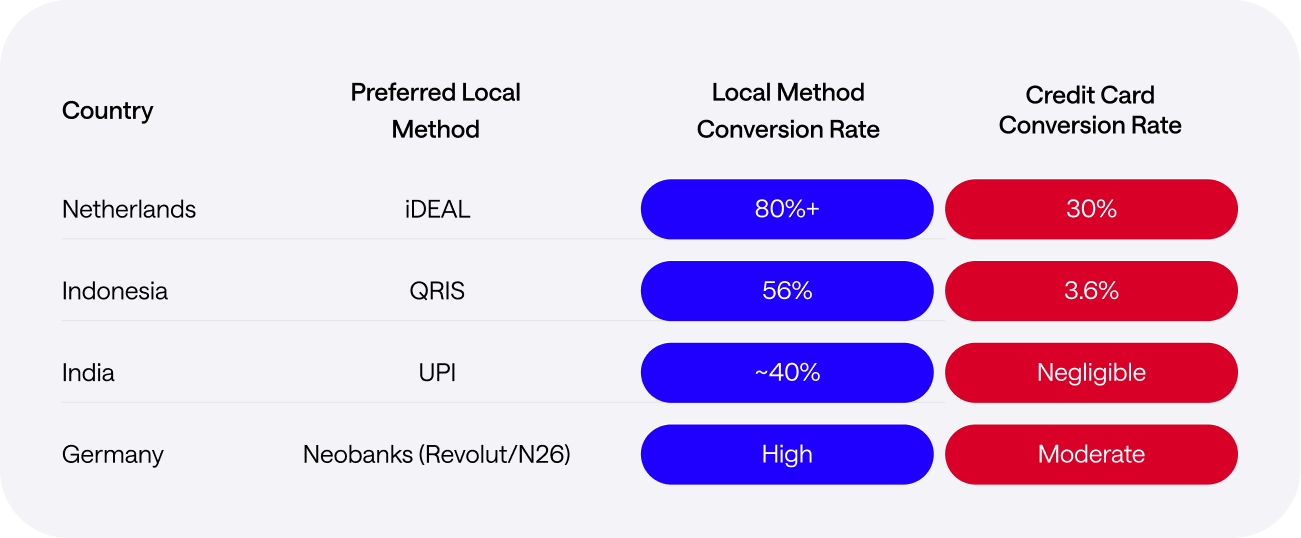
The Bottom Line: Recommending the right local payment method over a standard credit card leads to an average 132.2% increase in conversion rates.
4 Pillars of a High-Conversion Onramp Flow
Designing a world-class onramp requires moving beyond simple integration. You need a flow that prioritizes smart defaults and guided routing.
1. Hyper-Localize Currency & Payments
Nothing kills a user's momentum faster than irrelevance. If a user in Brazil lands on a checkout page denominated in USD, they often assume the product isn't for them.
- The Mistake: Defaulting to USD/EUR regardless of user IP.
- The Solution: Use Geo-IP detection to dynamically recommend the best local fiat-to-crypto pairs and APMs.
2. Contextual Integration
In 2026, the biggest killer of conversion is a lack of regional empathy. If a user sees a SEPA transfer request in a non-EU country, they will churn. You cannot simply "add an onramp"—you must integrate the right onramp for the user’s specific banking habits and trust preferences.
3. Balance Global Giants with Regional Specialists
Relying solely on "Tier 1" providers like Stripe or MoonPay is a common pitfall. While excellent for the US and UK, these giants often lack the specific rails needed for emerging markets.
- The Strategy: Use Smart Routing. Send New York users to Stripe, but route Southeast Asian users to regional specialists that support local e-wallets.
4. Eliminate Choice Overload
A user wants to get from fiat to crypto with the least resistance possible; they rarely care about the specific broker. However, because conversion rates vary wildly between providers based on the corridor, choice becomes a burden.
The Solution: An intelligent routing engine. Data shows that 80% of users will follow a pre-selected "Recommended" path. Smart Onramp Routing significantly improves conversion rates compared to traditional card routing across all continents.
By utilizing alternative payment methods, this intelligent routing system achieves much higher success rates, particularly in regions like Europe and North America, where conversion rates are substantially elevated. This approach optimizes the payment process, ensuring more seamless and successful transactions for users globally.
Beware of the "Price Trap"
A common mistake is ranking onramp providers solely by the lowest fee. While users say they want the cheapest option, ranking by price alone often destroys conversion for two reasons:
- Price Spoofing: Some providers advertise "0% fees" but hide costs in a massive spread. A "transparent" 2% fee is often cheaper than a "free" service with a 4% markup on the asset price.
- The Success Gap: The "cheapest" route often has the weakest banking relationships. If a user tries the cheapest option and it fails, they rarely try a second provider—they simply leave.
Pro-Tip: Always rank for Success Rate over Base Cost. It is better to show a provider that costs $1 more but has a 95% success rate than a "cheap" one that fails 60% of the time.
The "Smart Aggregation" Shortcut
Manually integrating dozens of providers to achieve global coverage is an engineering nightmare. This is where Onramper changes the game.
Instead of guessing which onramp is right for which user, an aggregator acts as a dynamic decision engine. Onramper’s algorithm analyzes:
- User Location (Geo-IP)
- Fiat/Crypto Pair (e.g., BRL to SOL)
- Real-time Success Rates for that specific corridor
The result? The user is automatically presented with the path of least resistance. You get the benefits of 30+ providers through a single integration, ensuring that whether your user is in Berlin or Bangkok, they have a localized, high-success way to join the ecosystem.
The Reality of Building Your Own Aggregator
If you’re thinking about building your own aggregator, you’re probably telling yourself what every ambitious Product Manager does:
“How hard can it be? We’ll integrate a few on-ramps and call it a day.”
On paper, it looks simple.
In practice, it’s a slow-motion product tax that compounds every quarter.
Here’s the very predictable lifecycle of an in-house aggregator—and why so many teams regret it.
Phase 1: The “Simple” Pilot
You start with 2–4 on-ramps. Within weeks, you realize:
- One provider lacks key payment methods
- Another doesn’t cover critical regions
- Edge cases are already piling up
The “MVP” is suddenly incomplete before it even launches.
Phase 2: The Expansion Trap
To fill the gaps, you add more providers.
Now you’re juggling:
- Conflicting APIs
- Different currency and payment method codes
- Inconsistent webhook behavior
Feature development slows to a crawl as engineers pause roadmap work just to refactor integration logic.
Phase 3: The Architecture Reckoning
Reality hits when:
- You realise many transactions fail
- You want to make sure you can monitor
- Onramps do not behave consistently
You discover you need custom fallback logic, smart routing, and resilient error handling—all built from scratch. Congrats, you’re no longer integrating onramps, you’re building core data infrastructure.
Phase 4: The Data & Reconciliation Nightmare
Customers and your product managers start reporting issues:
- Transaction statuses differ
- Quote spoofing is rampant
- Fee calculations are heterogeneous
- Definitions of success rates differ
- Reports don’t reconcile
Now you must design a unified data layer to normalize pricing, FX, fees, and reporting across every on-ramp.
This work is invisible to users—but brutally expensive to build.
Phase 5: The Realization
What began as “just a few integrations” has become:
- 12 months of development
- ~5 full-time engineers to get to production
- A system that still needs 2 dedicated FTE every year just to maintain, monitor, and fix
You’ve accidentally built a full payments platform.
And it demands constant firefighting, forever. Meanwhile, 4 new onramps just popped up that seem better than the ones you have. Congratulations - go back to start.
The Hidden Cost
The real damage isn’t just engineering headcount—it’s:
- Roadmap delays
- Opportunity cost
- Product teams stuck maintaining plumbing instead of shipping value
Building your own aggregator isn’t a one-time project.
It’s a long-term commitment you can’t easily unwind.
And that’s the part no one tells you at the start. 😬
The Bottom Line: If you want to maximize profits, focus on what grows your business. On-ramps should be outsourced.
Why Onramper Is the Best Crypto Onramp Solution
Onramper has established itself as the leading aggregator, solving the fragmentation problem of the crypto market. Here is why it is arguably the best onramp solution for 2026:
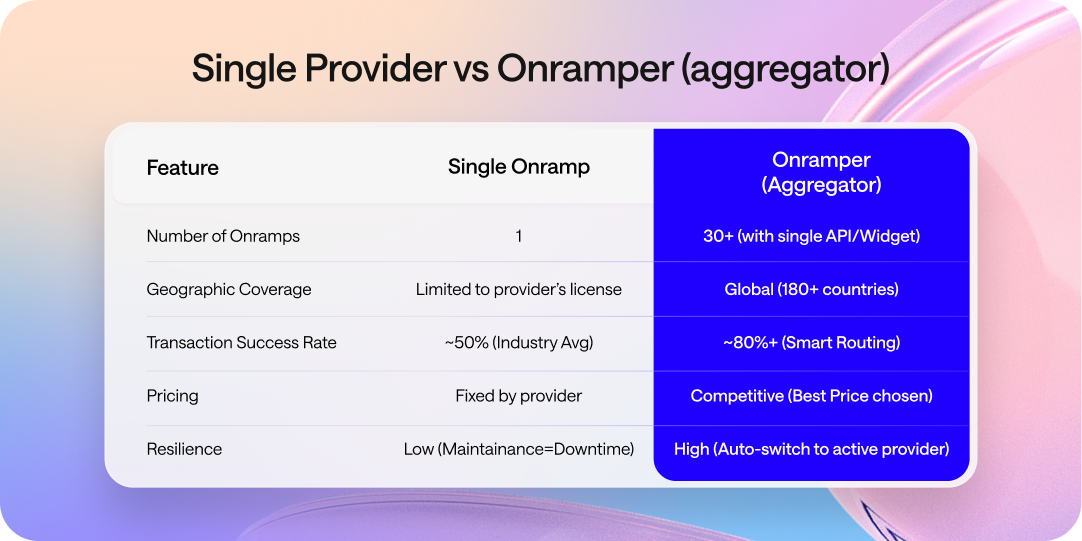
- Access to Multiple Providers: Integrates 30+ providers (including Banxa, MoonPay, Transak) via a single API, guaranteeing global coverage across 180+ countries.
- Intelligent Routing (Smart Engine): Dynamically routes users to the provider most likely to accept their transaction. If Provider A fails, Onramper suggests Provider B, saving the sale.
- Better Pricing & Availability: By aggregating quotes, users get the most crypto for their fiat. You can see providers competing for your transaction in real-time.
Higher Conversion Rates: Aggregators can boost transaction success rates to over 80%, whereas single providers often hover between 40-60%.
Conclusion
The "Best onramp" in 2026 isn't a single company—it's choice.
While providers like Stripe, Banxa, and Paybis offer excellent individual services, the fragmented nature of global finance means no single provider can win every time. For the most reliable, cost-effective, and successful way to enter the crypto market, onramp aggregators like Onramper represent the future. They remove the friction, optimize the fees, and ensure that the digital economy is accessible to everyone, everywhere.
Ready to optimize your entry into crypto?
- If you are a developer: Stop integrating providers one by one.
If you are a user: Look for platforms powered by aggregation. The future of crypto adoption is aggregated.
Other articles
Onramper Launches Chrome Extension to Compare Crypto Quotes From 30+ Providers Without Leaving the Page
Install in one click and see live quotes side by side in the browser’s side panel, with no analytics or tracking
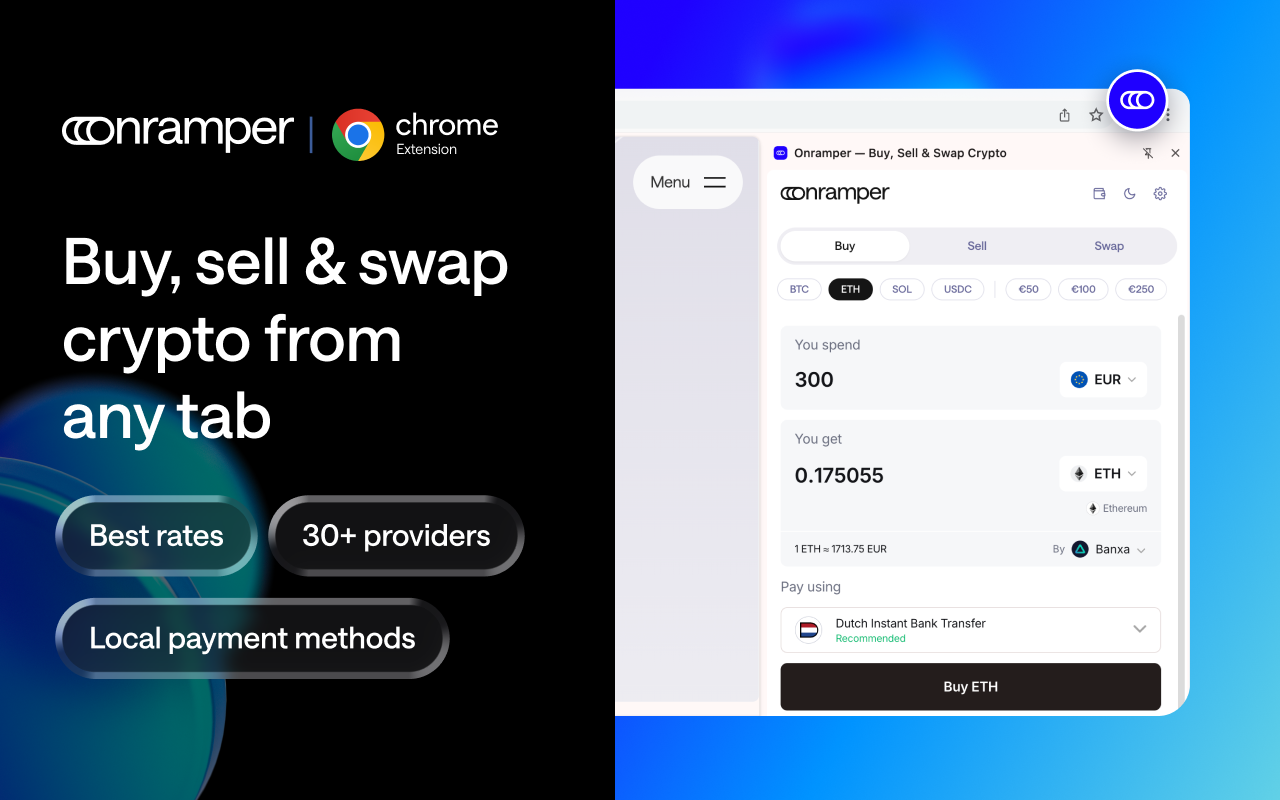
Amsterdam, October 22, 2026 — Onramper, the fiat-to-crypto onramp aggregator, today launched a Chrome extension that puts crypto buying, selling and swapping in the browser’s side panel, so users can transact while staying on the page they’re already reading. The extension is available now on the Chrome Web Store.
Buying crypto usually means leaving the webpage you are on. People spot a token or an idea, then have to open a new tab and check provider after provider. The Onramper Chrome extension keeps those comparisons in the Chrome Side Panel. Users can see live quotes from over thirty licensed providers in one place, pick the option that suits them and check out. The panel stays open while they browse, so there are fewer steps between spotting something and buying it.
“Crypto has treated the on-ramp as a destination: a separate site, a separate tab, a separate decision. As the industry matures, buying has to happen where people already are, and with more providers and payment methods in every market, comparing them should not be a research project,” said Rick Thomas, Co-CEO of Onramper. “Putting that choice in the browser is how we make a fragmented market simpler to use.”
The Onramper extension is private by default, containing no analytics or tracking. Settings and saved wallets stay in the user’s browser, and cross-device sync is off unless the user turns it on. A single control in the settings menu can erase all extension data.
What users can do with the extension
- Buy crypto with cards, bank transfers and local payment methods
- Sell crypto and cash out to a bank account
- Swap tokens by connecting a wallet in a browser tab
- View prices in their local currency, selected automatically, with one-tap amount presets suited to that currency
- Save up to five wallet addresses under recognizable names and copy one at checkout in a click
Onramper compares quotes from licensed providers and routes the user to the one they choose. Onramper and the selected provider handle identity verification and payment at checkout. Onramper offers 170+ local payment methods, and available providers, payment methods and assets vary by country. The Onramper extension is available now for Chrome.
About Onramper
Onramper is a fiat-to-crypto on-ramp aggregator based in Amsterdam. Wallets, exchanges and Web3 apps use Onramper’s widget and API to offer users a way to buy, sell and swap crypto. For more, visit onramper.com
Media Contact

Ult integrates Onramper to power seamless fiat access
We're excited to announce that Ult has integrated Onramper, bringing seamless fiat onramping to users directly inside the app.
Ult is a multi-market trading app that brings crypto, tokenized stocks, perps, and sports prediction markets into one experience. It gives users a single place to access multiple markets without juggling separate apps, separate accounts, or separate funding flows for each one.
Fund every market in one flow
Ult users can now fund their accounts with fiat through a single onramp integration, rather than relying on one payment provider with limited coverage. Onramper aggregates more than 15 onramp providers and automatically routes each transaction to the most competitive option based on location, payment method, and availability. Users get access to 175+ payment methods across markets, all inside one streamlined flow. Whatever they're trading– crypto, stocks, perps, or predictions– the funding experience stays the same.
"Onramper was built to give any product access to the best global onramp coverage through a single integration," said Rick Thomas, co-CEO of Onramper. "Ult is exactly the kind of app this infrastructure was designed for, multi-market, user-first, and built to remove friction at the exact moment users are ready to get started."
Ult with Onramper is available now. Open the Ult app to get started.
About Onramper
Onramper is the leading fiat-to-crypto payments aggregator, providing a turnkey API-based solution for dynamically routing fiat-to-crypto onramp flows based on algorithms optimizing for conversion, fees and payment methods. Onramper’s platform allows users of clients to buy 2000+ digital assets, in over 190 countries with over 130 payment methods in 120 currencies, with advanced routing options and unified analytics. The company is based in the Netherlands. To learn more about Onramper, visit www.onramper.com.

Guarda Wallet Integrates Onramper to Power Fiat to Crypto Access
Onramper brings native fiat purchasing to Guarda Wallet, live now on web and Android
We're excited to announce that Guarda Wallet has integrated Onramper.
Guarda Wallet is a non custodial, multi platform wallet supporting more than 70 blockchains and over 1 million assets. Founded in 2017, Guarda is available on desktop, web, mobile and browser extension–giving users full control of their private keys across every platform they use.
Onramper fiat purchasing is now live natively within Guarda Wallet on web and Android. Users can buy Bitcoin, Ethereum, Solana, XRP, Cardano, Litecoin, Dogecoin, TRON, and more directly inside the wallet, without needing to move funds elsewhere first.
Onramper aggregates multiple fiat onramp providers into a single, optimised flow, routing each transaction through the best available provider at the time of purchase. This gives Guarda users broader payment coverage and more reliable pricing without Guarda needing to manage multiple provider relationships on its own.
"Guarda has always been about giving users real ownership of their assets across every chain that matters," said a spokesperson for Guarda Wallet. "Onramper makes the path from fiat to self custody faster and more accessible for our users worldwide."
"Guarda is exactly the kind of wallet Onramper is built for: broad chain coverage, a committed user base, and a genuine commitment to non custodial principles," said Rick Thomas, Co CEO of Onramper. "This integration puts a reliable fiat onramp in front of millions of self custody users from day one."
Onramper is live now in Guarda Wallet on web and Android. To learn more, visit guarda.com.